
Stephens County Court Records After Arrest
Stephens County court records after an arrest are not the same thing as the jail booking entry. The local arrest may be made by the Stephens County Sheriff's Office, the Toccoa Police Department, or another law-enforcement agency. If the person is held locally, the custody side starts at the Stephens County Jail / Stephens County Detention Center. The court side begins as the charge moves into the county's criminal courts, where first appearance, bail, preliminary hearing, formal prosecution, and docket records are handled.
The Stephens County Magistrate Court page gives the first local court step. At first appearance, arrested persons are notified of the charges, a judge considers bail and release conditions, and the right to counsel is addressed. Preliminary hearings test probable cause on issued warrants. If probable cause exists, the case is routed to Superior Court for felony matters or State Court for misdemeanor matters. The Mountain Judicial Circuit District Attorney then reviews felony arrest evidence and may present the case to a grand jury.
For the custody side, use jail inmate records. For booking photographs, use jail mugshots. Court records after a jail arrest focus on the case record: charging documents, court dates, bond orders, docket entries, charge status, pleas, dismissals, and convictions when a conviction exists.
Booking to Stephens County Court Records
The arrest-to-court path in Stephens County is best read as a sequence: arrest, booking, first appearance, preliminary hearing, prosecutor review, grand jury or accusation, court docket, and final disposition. The jail creates the custody record when a person is booked. That record may list initial arrest charges, a booking date, bond status, and the agency that brought the person to the jail. Those entries can be useful, but they are not final court findings.
Magistrate Court is the first key court source after a jail arrest. The official Magistrate page says arrested persons are advised of charges and that the judge considers bail and conditions of release. The same page explains preliminary hearings. Those hearings decide whether there is probable cause to believe the defendant committed the alleged crime in the warrant. That finding does not decide guilt. It only decides whether the case moves forward.
Felony cases add another step. The District Attorney's Office for the Mountain Judicial Circuit serves Habersham, Rabun, and Stephens Counties. Its official page says that after an arrest on a felony punishable by one year or more in prison, the DA receives evidence, reviews testimony and facts, and later presents the matter to the grand jury. A true bill creates an indictment. If indicted, the felony is prosecuted in Superior Court.
Process flow: Arrest → jail booking → first appearance → preliminary hearing → prosecutor review → grand jury or accusation → court docket → plea, trial, dismissal, or sentence.
Find Stephens County Court Records
The Clerk of Superior Court is the local record keeper for criminal dockets and most court records. The Stephens County Clerk of Superior Court page says the clerk maintains criminal and civil dockets, court records, and court calendars, and that most court records are public and may be viewed in the clerk's office. The clerk's office is at 70 N. Alexander St., Suite 202, Toccoa, GA 30577, and the listed phone is 706-886-9496.
Georgia also uses statewide electronic access channels. The Georgia Courts e-access page directs users to court-record providers and says an account is required to search court records. The research capture found Stephens State listed in the e-access material, but no located Stephens Superior portal listing in that captured text. The re:SearchGA portal is the public-access court-record portal referenced by Georgia resources; its exact searchable fields should be checked at the live portal because the research file did not capture a full Stephens-specific field inventory.
- Start with the Stephens County Clerk if the case may be in Superior Court or if a docket copy is needed.
- Use Magistrate Court for first appearance, preliminary hearing, warrant, and bond-stage questions.
- Check Georgia Courts e-access and re:SearchGA for online case access, account requirements, and court availability.
- Compare the filed court charges against any jail booking charges before relying on either list.
- Use the county open-records process for jail, arrest, or incident records that are not court docket records.
The Georgia Courts e-access page is a useful statewide starting point for electronic access, and its provider list is separate from the clerk's in-office public access.
Georgia Courts e-access shows the provider route for case-record access.
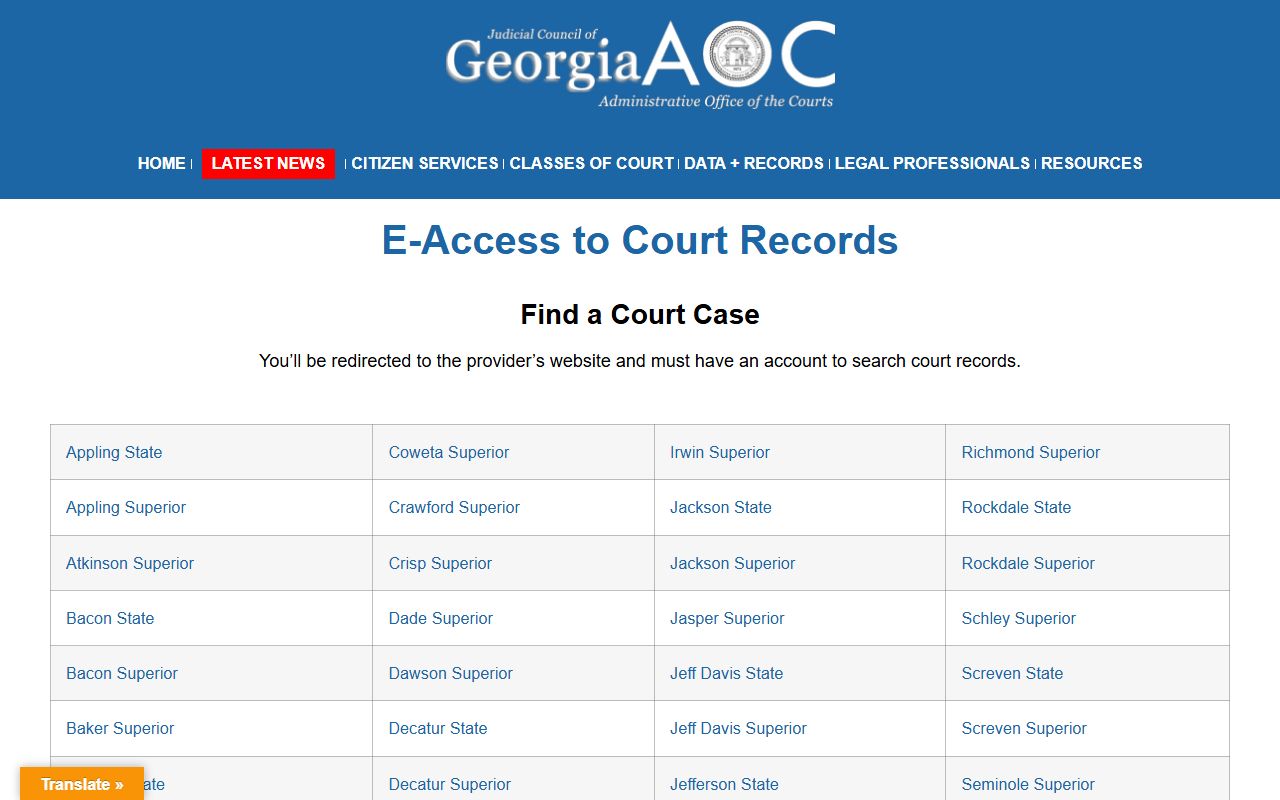
Use the court name shown in the provider list carefully, because the research located Stephens State in the e-access list but did not locate a Stephens Superior entry in the captured text.
Stephens County Court Access Channels
Court access in Stephens County is split between local offices and statewide portals. That split matters after a jail arrest because a recent booking may exist before the court record is easy to find online. A clerk search, Magistrate Court contact, and DA or court-calendar review may be needed when the case is new, amended, or still moving between charge stages.
| Channel | Use For | Stephens County Notes |
|---|---|---|
| Clerk of Superior Court | Criminal dockets, court records, calendars, in-office viewing | 70 N. Alexander St., Suite 202; phone 706-886-9496. |
| Magistrate Court | First appearance, bail consideration, preliminary hearings, warrant-stage matters | Explains probable cause hearings and case routing to Superior or State Court. |
| Superior Court | Felony cases and general jurisdiction trial-court matters | Stephens County is in the Mountain Judicial Circuit. |
| District Attorney | Felony prosecution and grand jury review | Mountain Judicial Circuit DA serves Stephens, Habersham, and Rabun Counties. |
| Georgia Courts e-access | Provider-based online court access | Account required; captured list showed Stephens State, not a located Stephens Superior entry. |
| re:SearchGA | Public-access portal for Georgia case records | Account may be required; do not assume all local court records are online. |
| Open records request | Jail, arrest, incident, or non-court agency records | Use precise names, dates, case numbers, and delivery method. |
Charging Documents After Arrest
Charges can change after booking. A jail entry may reflect what the arresting officer supplied at intake, while the court record reflects what is filed and prosecuted. In Stephens County felony cases, the District Attorney's page is the key source for the grand-jury path. The DA reviews evidence after the felony arrest and presents the case to the grand jury for a possible true bill. Misdemeanor cases may move through State Court after the Magistrate Court stage.
| Document | Who Usually Initiates It | Role in the Court Record |
|---|---|---|
| Complaint or warrant papers | Law enforcement, prosecutor, or court process | Supports the early charge or warrant-stage accusation after arrest. |
| Information or accusation | Prosecutor | States formal charges in cases that proceed without a grand-jury indictment. |
| Indictment | Grand jury after DA presentation | Formal felony charge returned as a true bill when sufficient grounds are found. |
Do not treat a booking charge as a conviction. The court record is the place to verify whether the prosecutor filed a different charge, reduced a count, dismissed a count, or obtained an indictment.
Stephens County Charge Status
Charge status is the practical language of court records after a jail arrest. It tells whether a charge is still moving, was changed, was dropped, or led to a final judgment. The status can differ by count. One defendant may have several charges from one arrest, and each charge can have its own bond setting, amendment, dismissal, plea, or sentence.
| Status | What It Means | What to Check |
|---|---|---|
| Pending | The charge is open and no final disposition has been entered. | Next court date, bond order, and current court. |
| Amended or reduced | The filed charge changed from the booking or earlier court charge. | Original charge, amended count, and prosecutor filing. |
| Dismissed | The court record shows the charge did not proceed to conviction. | Dismissal order and whether other counts remain. |
| Nolle prosequi | The prosecutor chose not to pursue that charge at that time. | Filed nolle entry and any remaining case counts. |
| Indicted | A grand jury returned a true bill on felony charges. | Indictment count, Superior Court docket, and arraignment date. |
| Convicted | A guilty plea, verdict, or other conviction disposition was entered. | Sentence, probation terms, jail credit, and appeal status. |
Bond After Jail Arrest
Bond information can appear in both custody records and court records. The Stephens County Magistrate Court page says first appearance hearings include bail consideration and possible release conditions. If the judge is not authorized to set bail, or declines to set bail, the defendant is notified. Bond may also be reconsidered later as the case moves through preliminary hearing, prosecutor review, or a higher court.
Georgia bond terms include cash bond, surety or commercial bail bond, property bond, recognizance bond, and no-bond hold. The research did not locate a Stephens County official page with bonding-company rules, bond-desk hours, accepted payment types, or online bond payment links. Current bond posting instructions should be confirmed with the Stephens County Jail at 706-886-2514 before money is sent or a bondsman is retained.
| Bond or Hold Type | How It Works |
|---|---|
| Cash bond | Money is posted directly under the court's bond order, subject to local acceptance rules. |
| Surety bond | A commercial bonding company posts bond under Georgia bail-bond practice. |
| Property bond | Property may secure release when the court and local rules allow it. |
| Recognizance or personal bond | The court releases the person on a promise to appear, usually with conditions. |
| No-bond or detainer hold | Release is blocked by a judicial hold, another agency hold, ICE detainer, probation/parole hold, federal hold, or similar restriction. |
Stephens County HB 1105 reports show local ICE-detainer activity: 9 detainers in Q1 2026, 3 in Q4 2025, and 1 in Q3 2025. Those figures do not make the jail an ICE detention center, but they explain why a person may remain in jail even when a local bond question appears resolved.
Warrants and Court Records
No official Stephens County active warrant list, public warrant-search portal, or most-wanted page was located in the research. The sheriff's official duties include serving criminal warrants, and Magistrate Court handles pre-warrant applications and preliminary hearings tied to issued warrants. A warrant arrest can produce both a jail booking and a court record, but the public access route depends on whether the person has been booked, whether the warrant has generated a filed case, and which court has the matter.
For custody after a warrant arrest, call the Stephens County Jail at 706-886-2514. For sheriff warrant questions, use the sheriff main number, 706-886-2525. For city police matters, Toccoa Police lists 706-282-3244 during business hours and 706-779-3911 for dispatch or after-hours non-emergency service. A person who may have an active warrant should not be told to appear at the jail or courthouse without legal advice, because contact with law enforcement may result in arrest.
Charges vs Convictions
A charge is an accusation. A conviction is a court outcome. That distinction is central to Stephens County court records after a jail arrest because the first public facts may be arrest-based, while the court record may later show dismissal, reduction, plea, verdict, sentence, or no prosecution on a count. The presumption of innocence remains unless a conviction is entered by plea or judgment.
| Charge | Conviction | |
|---|---|---|
| Stage | Allegation after arrest or formal filing | Final finding by plea, verdict, or judgment |
| Proof level | May be based on probable cause or prosecutor filing | Requires the legal standard for conviction |
| Where to verify | Booking record, charging document, clerk docket | Judgment, plea record, sentence, or disposition entry |
| Common mistake | Treating every booking charge as final | Assuming a conviction exists without a disposition |
Sealed vs Expunged Records
Georgia public access is broad, but it is not unlimited. The Georgia Open Records Act covers public records unless an exemption applies. Some juvenile records, sealed records, active investigation materials, restricted records, and legally exempt items may not be available to the general public. If Stephens County withholds a requested record, the open-records process should identify the legal authority for withholding it.
Georgia commonly uses the language of record restriction, and people often use the words sealed or expunged in a general way. The practical point is the same for a public searcher: not every arrest or dismissed charge will remain visible in the same way to the public. Eligibility depends on the disposition, the record type, and Georgia law. For legal relief, use the court, an attorney, or official state guidance rather than a casual web search.
| Sealed or Restricted | Expunged or Removed | |
|---|---|---|
| Public visibility | Hidden or limited for ordinary public access | Removed or treated as unavailable under the applicable rule |
| Official access | Certain agencies or courts may retain access | Official access depends on the legal process used |
| Typical trigger | Eligible dismissal, restriction, juvenile matter, or court order | Specific statutory or court-authorized process |
| What to verify | Restriction order and clerk record | Final order and agency compliance |
Open Records After Arrest
Use open records for jail, arrest, incident, or agency materials that are not court docket records. Stephens County says the county clerk is the official custodian for open-records requests. Requests may be oral or written, but the county recommends written requests for clarity. The open-records form lets the requester describe the record, include date and time of incident, and choose delivery by in person, fax, email, or mail.
Georgia's open-records timing rule generally requires production within three business days or an explanation of timing, cost, or exemption. Stephens County's form notes that the first 15 minutes of research are not charged, and that fees may apply for additional research time, copies, discs, or thumb drives. For immediate current-custody information after a jail arrest, call the Stephens County Jail before filing a records request.
Important: Public-record summaries are not consumer reports under the FCRA and cannot be used for employment, tenant, credit, insurance, or similar screening decisions.
Restricted Stephens County Court Records
Some court records after arrest may be unavailable online or may require direct contact with the clerk. Examples include juvenile matters, sealed or restricted records, records affected by statutory exemptions, and material tied to an active investigation. Online portals also may not show every local court, every docket event, or every new filing immediately.
When a Stephens County case cannot be found online, check the court level before concluding that no record exists. A new arrest may still be in Magistrate Court. A felony may be under DA review before indictment. A misdemeanor may route differently than a felony. The most reliable court-record path is to match the charge stage with the right office: Magistrate Court for first appearance and preliminary hearing, District Attorney for felony prosecution context, Superior Court for felony jurisdiction, and the Clerk of Superior Court for dockets and record viewing.